
The other day my girlfriend was playing tennis and her partner having forgotten to bring his own racket borrowed one and then proceeded to play very badly. "It's this useless racket!" he complained, "It's ruining my game!"
"
弘法筆を選ばず!" says my girlfriend, (
こうぼうふでをえらばず) - literally
Koubou doesn't need to choose his brush! To which her tennis partner replied:
"
弘法も筆の誤り" (
こうぼうもふでのあやまり)- literally
Even Koubou's brush makes mistakes!
So, who is this Koubou guy and why are two young people talking about his brush during a game of tennis?
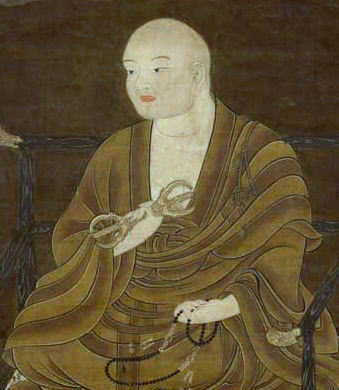
Well I'll tell you, because that was a rhetorical question, and also because in order to properly understand a language it's a good idea to know the culture of which it is a part. Koubou Daishi is a semi-legendary figure in both Japanese Buddhism and Japanese culture in general. Historically he was a monk, scholar, artist, poet, calligrapher and a civil engineer! In addition, to wearing all those hats he also has several names, known as
空海 - Kukai - during his life,
弘法大師 - Koubou Daishi was the Buddhist name (meaning
Great Teacher of the Dharma) given to him posthumously and as a Buddhist saint he is known affectionately as
Odaishisama. In his twenties he spent much of his life on ascetic retreat in the mountains or travelling from temple to temple pursuing meditative practice, until one night he had a dream in which it was revealed to him that the
Mahavairocana Sutra was the key to his enlightenment. In order to study this sutra more closely, he travelled to China in AD 804. This was no small thing in those days, China would have seemed a world away and the journey hazardous. Indeed in a fleet of four ships, one turned back on encountering rough seas and another sank. In China he studied and was initiated into the rituals of esoteric Buddhism, and on returning to Japan two years later, he introduced the esoteric school of Shingon (
真言 or True Word) Buddhism, the teachings of which can be (very) briefly summed up as follows:
Enlightenment or realisation of one's own Buddha nature is not unattainable and does not require a lifetime (or lifetimes!) of study and practice to achieve. Everyone has this inner wisdom within them already and with proper training of mind and body through ritual and meditative practice and the help of an enlightened master we can free this inner potential for ourselves and for others... More on the 真言 school on Wikipedia.If you want to read more about
弘法大師 there's a nice introduction on
The Jayarava Rave blog, with information on other resources and links to other relevant sites. Getting back to today's language point, though, it is as a famous calligrapher that he is remembered in those two expressions. Indeed,
弘法大師 was known as one of the
三筆 (sanpitsu -
Three Brushes) or three great calligraphic masters of his age. So the first expression
弘法筆を選ばず means that
弘法大師's skill as a calligrapher was so great, it really didn't matter what brush he chose. In other words:
A good workman doesn't blame his tools. The rejoinder
弘法も筆の誤り means that even Koubou despite being one the greatest calligraphers sometimes made mistakes whith his brush. In other words
Nobody's perfect.
Not even me!If you would care to see some examples of
弘法大師's calligraphy there is a little bit up
here.


.JPG)


